Enhancing Lithium-Ion Battery Safety: Insights from FM Data Sheet 7-112 and the SFPE Engineering Solutions Symposium: Progress with Li-ion Battery Fire Safety
Since Sony’s first commercial introduction of lithium-ion batteries in 1991 (Gerald, 2024), these energy storage systems have revolutionized industries with their unparalleled power density and...
Since Sony’s first commercial introduction of lithium-ion batteries in 1991 (Gerald, 2024), these energy storage systems have revolutionized industries with their unparalleled power density and versatility. They have become the backbone of modern technologies. Powering everything from consumer electronics to electric vehicles (EVs) and renewable energy storage systems. Yet, as lithium-ion technology has advanced rapidly, safety and regulatory measures have struggled to keep pace, posing significant risks.
However, the swift commercialization and advancement of lithium-ion systems have outpaced the development of regulatory guidelines, codes, and standards. This gap became evident in 2017 when FM Global published the first widely recognized standard addressing the hazards associated with stationary battery energy storage systems (BESS). The design of FM Data Sheet 5-33, Electrical Energy Storage Systems, minimizes risks by providing guidance on the installation, protection, and human element programs for BESS utilizing lithium-ion batteries.
Since then, global standards organizations have been working to better understand the risks of lithium-ion batteries through rigorous testing, scientific collaboration, and the development of updated codes and standards. The 2021 article Property Loss Control for Lithium-Ion Energy Storage Systems (ESS) highlights these efforts and details evolving guidelines for loss prevention. Yet, the continuous development of battery technology, alongside frequent reports of lithium-ion-related fires—such as the recent incident at a recycling facility in Missouri—underscores the importance of staying ahead of the risks associated with these systems.
This article explores the vital role of FM Data Sheet 7-112, Lithium-Ion Battery Manufacturing and Storage, published in October 2024, in mitigating these risks. Additionally, it highlights key insights from the Society of Fire Protection Engineers (SFPE) Engineering Solutions Symposium, which convened industry experts in June 2024 to discuss fire safety challenges and emerging solutions for lithium-ion systems.
Understanding FM Data Sheet 7-112, Lithium-Ion Battery Manufacturing and Storage
Published in October 2024, FM Data Sheet 7-112 addresses fire protection and risk management across the lifecycle of lithium-ion batteries, including cell manufacturing, assembly, storage, and end-use product integration. It identifies critical hazards such as thermal runaway, mechanical and thermal abuse, fire, reignition, and explosion, while offering strategies to mitigate these risks.
Key Components of FM Data Sheet 7-112:
- Fire Detection and Protection: Advanced detection systems using heat and gas sensors are essential to identify failures early. While automatic fire suppression systems cannot extinguish lithium-ion battery fires directly, they can protect surrounding structures and equipment.
A minimum sprinkler design of Hazard Category 3 (HC3), nearly Extra Hazard Group 1 per NFPA 13, is recommended to protect the assembly and manufacturing areas.
For rack storage arrangements storing work in process, vertical barriers spaced up to 6 ft. apart are needed to limit horizontal fire spread. Horizontal barriers are recommended at each tier up to 6 ft. vertical spacing; up to 3 in. gaps are permitted a min. of 8 ft. apart. In-rack automatic sprinklers spaced 2-5 ft. horizontally within 6 in. of each transvers flue space are also recommended for each tier. In double-row racks, the face sprinklers can be installed at 4-10 ft. spacing at every other load.
For protecting formation and aging bin-box and enclosed chambers, the protection system should be capable of at least 60 gpm for the six remote heads in the area/chamber. If multiple trays of cells are stored, ensure water can reach the bottom tray.
If work in process storage is limited to 200 sq. ft. areas, 6 ft. high, the state of charge (SOC) is Γëñ60%, and the storage piles are at least 10 ft. apart, the low-piled storage in plastic containers should be treated as uncartoned unexpanded plastics (UUP). Use Table 2.4.3.2 for the recommended UUP protection. If stored in metal containers, protect the area for the surrounding occupancy.
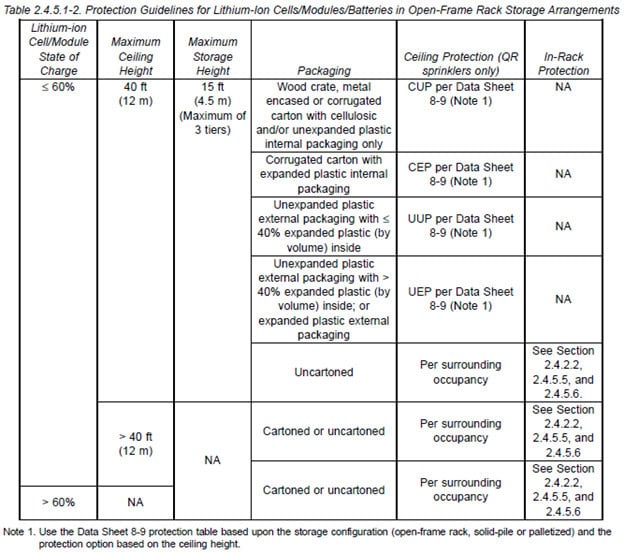
Tables 2.4.5.1-1 and 2.4.5.1-2 have the recommended protection guidelines for completed cells/modules/batteries stored in solid-pile or palletized storage and rack storage respectively.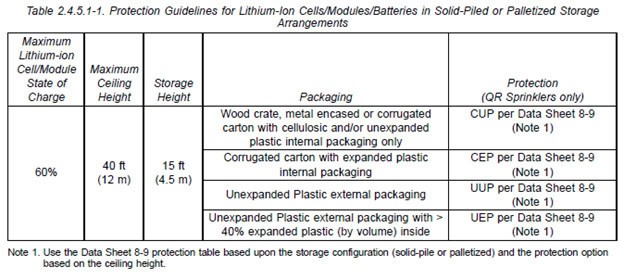
The storage layout is also used to limit fire spread to and from the lithium-ion storage piles. A minimum of 10 ft. clear space is needed to nearby combustibles and 10-ft. aisles are recommended between solid-pile and palletized storage arrangements. The maximum depth of a solid-pile or palletized array is 15 ft.
For these completed cells/modules/batteries in racks, the horizontal barriers can be up to 12 ft. apart. In multiple-row racks, vertical barriers are needed approximately every 20 ft. apart.
Once in a finished product, protect the commodities per the overall commodity classification if the SOC is Γëñ60%. When stored with a SOC >60%, use a protection option that requires in-rack automatic sprinklers.
When an automatic storage and retrieval system (ASRS) is used, guidelines in FM Data Sheet 8-34, Protection for Automatic Storage and Retrieval Systems should be followed for the commodity, excluding the battery, if the SOC is Γëñ30%. When the SOC is between 30 and 60%, determine the classification of the commodity excluding the battery and place the finished product in an FM Approved, non-flame propagating container, solid-walled metal containers, or solid-walled metal-lined containers (min. 18 ga. steel) and store in a horizontal-loading ASRS only. Protection for these ASRS is limited to wet systems only.
Store defective or damaged cells/modules/batteries apart from storage areas by keeping them in a cutoff room or outside at least 10 ft. from noncombustible walls or 20 ft. from combustible walls. If using a cutoff room, use a protection design of 0.3 gpm/sq. ft. over the footprint of the room.
In general, a hose stream allowance of 500 gpm and a duration of 2 hrs. is needed. - Thermal Management: Measures to limit the spread of thermal runaway events, such as improved cooling and containment strategies, are emphasized. Providing higher levels of protection will limit the overall loss.
- Ventilation and Containment:  Proper ventilation ensures the dispersion of flammable gases and prevents explosive conditions. Emergency ventilation systems should activate at 25% of the lower explosive limit (LEL).
Containment measures to limit fire and smoke damage include using fire-rated construction, sealing penetrations, using fire dampers, and shutting down the heating, ventilation, and air-conditioning systems. - Location and Layout Considerations: Recommendations for system placement prioritize minimizing exposure to high-risk areas, such as flammable materials or critical infrastructure. To enhance safety, construction should incorporate one-hour fire-rated, noncombustible walls to separate manufacturing, formation/aging, and warehouse storage areas. Additionally, strict adherence to spacing guidelines for solid-pile and rack storage is essential to ensure effective fire containment and protection.
- Management Protocols: Regular maintenance and inspections are essential, as is the implementation of a comprehensive management-of-change protocol to reduce future risks.
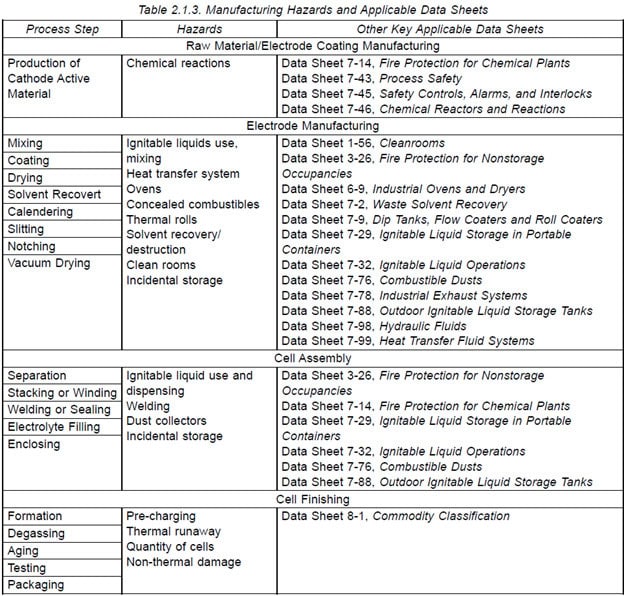
Table 2.1.3 provides a convenient list of other FM Data Sheets that are appliable to the various steps of the manufacturing process:
Insights from the SFPE Engineering Solutions Symposium - Progress with Li-ion Battery Fire Safety
The SFPE Engineering Solutions Symposium serves as a platform for discussing cutting-edge research, advancements, and practical challenges in fire safety. The 2024 symposium focused on four key areas: Thermal Runaway Hazard Fundamentals, Codes and Standards, Bulk Storage of Battery Products, and Hazards of Deployed Products.
Symposium Highlights:
- Thermal Runaway Hazard Fundamentals: Presenters explored battery chemistries and coatings designed to resist thermal runaway, a leading cause of lithium-ion fires.
Sean Yang, Senior Research Engineer of UL Solutions presented on battery structure, providing an overview of the components of the battery, different cell chemistries, and specific design forms.┬á The key take away from this presentation was the notable increased energy density and instability of NCM – nickel cobalt manganese and NCA - nickel cobalt and aluminum cathode technology vs. other cathodes like LFP – Lithium Iron Phosphate or LMO – Lithium Manganese Oxide.
Lucy Buannic, PhD, Senior Scientist, Exponent discussed thermal runaway and its causes. “When a battery cell goes into thermal runaway, it is often too late to reverse the course of action and stop the exothermic reaction from happening.” Causes of thermal runaway include internal cell faults (manufacturing defects, improper cell use, or inhomogeneous ageing) and external events (thermal and mechanical abuse). The general observation is that the higher SOC, the faster and easier it is for thermal runaway to propagate between cells regardless of other factors. - Codes and Standards: Robert Marshall, Deputy Fire Chief, San Mateo Consolidated Fire Department indicated that there is no current data capture on lithium-ion battery fires for the industry and code organizations to learn and understand the trends related to different devices. The consensus is that there is much less fire hazard when the SOC of cells/modules/batteries is Γëñ30%.
According to William E Koffel, PE, FSFPE, SASHE, Koffel Associates, Inc., Director of the Online FPE Undergraduate Program, University of Maryland, “regulations and standards for ESS are continually evolving to accommodate technological advancements and safety considerations. Staying updated with local and national regulatory bodies is crucial for all safety professionals involved in the energy storage, EV, and micro mobility sectors. The starting point regarding codes and standards will be the requirements in the 2024 Edition of the International Fire Code and the 2023 Edition of NFPA 855.”
The US Fire Administration is working to efficiently collect fire data. The National Emergency Response Information System (NERIS) is a real time system that will replace the legacy systems currently used. This platform will build risk data, from FEMA, DOD, USGS, and the National Weather Service, and will use API to grab data from other sources. It will ensure good quality information and standardization of the data. - Bulk Storage of Battery Products: Phil Friday, PE, FSFPE, The Reliable Automatic Sprinkler Co., Inc. revealed that UL is testing various Li-ion storage configurations, including ASRS. The cells are forced into thermal runaway, and the performance of the sprinkler protection schemes are assessed. A video of the Reliable Model LB11 HSW Large-Scale Fire Test showed that it is effective at protecting single-row racks of 18650 cells at 100% SOC. See Bulletin 084 for more information.
FM’s Benjamin Ditch, Principal Research Engineer & Stephanie Thomas, Senior Staff Engineering Specialist highlighted that risk mitigation guidelines for the Li-ion battery industry have lagged. He indicated that FM is also actively pursuing effective protection schemes. See the key components of FM Data Sheet 7-112 above. - Hazards of Deployed Products: Christina Francis, PE, FSFPE, CFPS, Sr. Staff Fire & Regulatory Specialist, Tesla employed risk management strategies aimed at preventing losses. These included properly trained employees, battery management response, quick activation of a well-equipped fire service, pre- and post-fire plans, and continuous improvement.
Lessons learned from the Lahaina, Maui fire event include ways to reduce the energy stored in Li-ion battery packs (EVs, etc.). Used cells were soaked in a saltwater solution for hours, then crushed. Despite soaking and crushing some of the cells continued to vent off-gasses preventing them from being transferred off the island.
The Intersection of FM Data Sheet 7-112 and the SFPE Engineering Solutions Symposium
While FM Data Sheet 7-112 provides a robust framework for fire safety in battery storage systems, the Symposium adds value by addressing ongoing research and practical challenges. Together, they present a roadmap for enhancing the safety and reliability of lithium-ion technology.
Call to Action:
- For Engineers and Designers: Familiarize yourself with FM Data Sheet 7-112, NFPA 855 and UL9540A to ensure compliance and optimize system safety.
- For Industry Stakeholders: Leverage findings from the symposium to stay updated on the latest safety solutions and regulatory trends. Use advanced risk engineering services, such as Risk Logic, to assess current hazards and evaluate the impact of your planned changes.
- For Policymakers: Collaborate with technical experts to refine standards that address the dynamic risks of lithium-ion technology.
As lithium-ion technology continues to drive progress, aligning innovation with rigorous safety measures will be crucial. FM Data Sheet 7-112 and forums like the SFPE Engineering Solutions Symposium are instrumental in achieving this balance, paving the way for a safer, more sustainable future.
Take the next step—contact Risk Logic today to explore how our expert risk engineering services can help you identify and mitigate hazards effectively. Together, we can create a safer future for your organization and its stakeholders.