Property Loss Prevention in AI-Driven Data Centers and Cloud Computing Facilities
Protecting High-Density Compute, Lithium-Ion UPS, and Mission-Critical Infrastructure Global data use continues to compound at an exponential rate. Modern data centers form the backbone of this...
Protecting High-Density Compute, Lithium-Ion UPS, and Mission-Critical Infrastructure
Global data use continues to compound at an exponential rate. Modern data centers form the backbone of this activity, supporting cloud computing, AI training, AI inference, streaming services, enterprise systems, and digital transactions. The operating environment has evolved rapidly. Hyperscale development is accelerating, AI workloads are driving unprecedented rack densities, and lithium-ion energy storage is reshaping electrical-system configurations. These trends sharpen both the frequency and severity potential of property loss, underscoring the critical importance of AI-Driven Data Center Property Loss Prevention for safeguarding mission‑critical infrastructure.
This article provides a comprehensive, standards-based review of the primary hazards affecting data centers and cloud-computing environments. It outlines the protection strategies used to reduce loss potential across fire, natural hazards, power reliability, and liquid-release exposure. Guidance is drawn directly from FM, NFPA, and UL standards, as well as high-level industry analyses. For more details regarding NFPA Codes & Standards and FM Data Sheets and Approvals, please see the referenced information below.
Industry Landscape and Risk Drivers
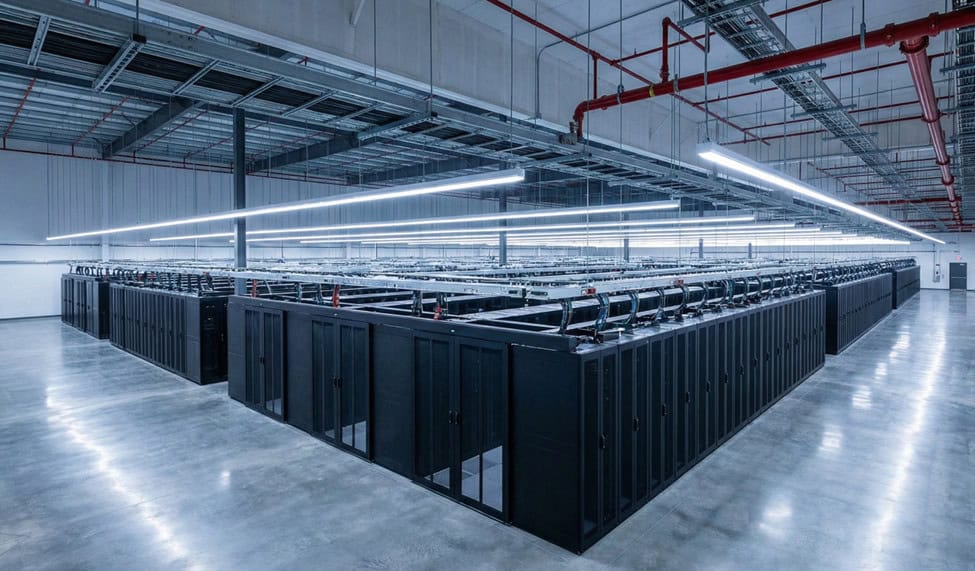
The growth in hyperscale data centers is significant. There are now roughly 1,189 hyperscale sites worldwide, which is double the total from five years ago. Compute demand continues to rise, particularly due to AI workloads that commonly exceed 20 to 40 kW per rack. Some deployments now surpass 200 kW per rack. These loads stress electrical distribution, mechanical cooling, energy-storage systems, and building infrastructure in ways not present in legacy facilities.
AI availability and global cloud computing remain driven by platforms such as Cloudflare, AWS, and Microsoft Azure. Cloudflare’s edge network supports low-latency API delivery and cyber-resilience functions. AWS continues to build GPU-dense infrastructure and is still the dominant cloud provider. Azure grows through integration of AI into enterprise platforms. Their expansion increases demand for hyperscale and regional edge compute, which heightens exposure concentrations.
Colocation facilities and carrier hotels remain critical for organizations that prefer third-party infrastructure. These sites host large volumes of privately owned equipment. Their diversity of tenant installations often increases complexity and adds challenges related to cable management, combustible loading, and variation in operational discipline.
AI-driven facilities now rely heavily on lithium-ion UPS systems. According to Uptime Institute, Eaton, Schneider Electric, and Vertiv, operators are transitioning away from VRLA batteries due to longer service life and higher energy density. This shift changes the risk landscape. Thermal-runaway potential and the performance characteristics of lithium-ion batteries elevate fire protection, detection, ventilation, and siting considerations.
Global research from IEA, Synergy Research, JLL, and McKinsey shows that AI deployments are placing additional strain on utility grids. This trend increases reliance on redundant generator plants, advanced UPS systems, and energy-storage configurations. Robust power resilience has become foundational to property loss prevention.
Primary Hazards and Loss Prevention Strategies
The information that follows consolidates the core hazards, their associated risk characteristics, and the recommended controls. It is aligned directly with the standards referenced in the uploaded document.
1. Fire Hazards and Recommended Controls
Data centers contain energized electrical equipment, large cable bundles, combustible materials, and high airflow. These conditions can accelerate smoke spread and complicate suppression. Fire loads have shifted due to higher power densities, lithium-ion systems, and modern containment materials.
Energized Electrical Equipment
Fires in energized equipment typically grow slowly but produce corrosive black smoke. They cannot be fully extinguished until power is isolated. Smoke contamination can result in extensive service interruption and equipment loss.
Controls:
- Install fire detection and suppression systems as required in FMDS 5-32 and NFPA 75.
- Provide shutdown capability for affected equipment without jeopardizing critical systems.
- Use aspirating smoke detection for early warning in high-density areas.
Grouped Cables and Wires
Cables commonly use combustible insulation (PVC, polypropylene, polyethylene, etc.). Large bundles create channelized fire paths, especially in vertical configurations and multi-tier trays.
Controls:
- Use Group 1 non-fire-propagating cable per FMDS 5-32 and FM Approvals Standard 3972.
- Acceptable alternatives include cables with flame-spread less than 5 feet per NFPA 262.
- Avoid unnecessary combustibles in cable trays and maintain proper spacing.
Cable Trays and Raceways
Routing assemblies may be combustible if constructed of plastics. This increases fire-propagation potential.
Controls:
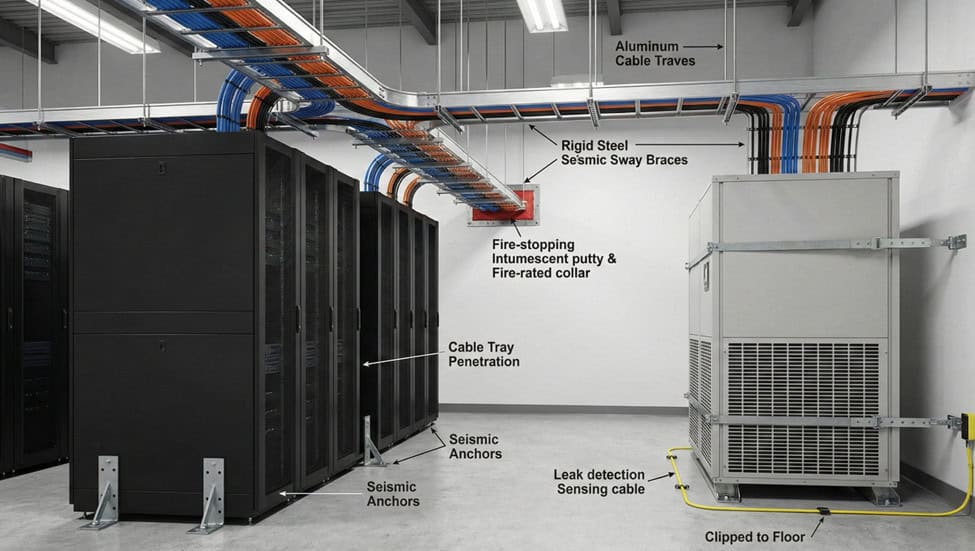
- Use noncombustible materials or assemblies in compliance with FM 4910.
- For plenum-rated applications, ensure UL 2024 listing and compliance with NFPA 262.
- Follow FMDS 5-31 for multi-tier-tray fire protection.
Combustible Insulation Materials
Combustible foam insulation in raised floors, piping, ductwork, or CRAC units increases vertical fire spread potential.
Controls:
- Use noncombustible insulation or FM 4924 and NFPA 274 approved materials.
- Maintain clear separation between insulated components and ignition sources.
Hot and Cold Aisle Containment
Containment structures are often constructed from plastic. Elevated rack densities increase temperatures within hot aisles, increasing material stress.
Controls:
- Use noncombustible materials or plastics approved under FM 4882 or FM 4910.
- Provide fire detection and suppression consistent with the current versions of FMDS 2-0, 4-9, and 5-48, and NFPA 13, 72, and 2001.
2. Natural Hazard Exposures
Natural hazards have become more significant as data centers expand into diverse regions. Disruptions from flood, seismic activity, wind, or wildland fire can cause catastrophic outages.
Flood Exposure
Avoiding a 500-year floodplain is essential. Floodwater can damage electrical equipment, generators, and mechanical systems.
Controls:
- Follow FMDS 1-40 and FMDS 5-32 when evaluating flood risk.
- If located in a flood-prone region, elevate critical equipment, harden building systems, and install barriers.
- Ensure drainage infrastructure can accommodate extreme rainfall events.
Earthquake Exposure
Seismic activity affects racks, raised floors, sprinkler systems, and gas piping.
Controls:
- FMDS 5-32 (2025) clarifies that seismic protection extends to data processing equipment.
- Brace sprinkler systems according to FMDS 2-8 and NFPA 13.
- Install seismic gas shutoff valves and protect piping consistent with FMDS 1-11.
Windstorm Exposure
Envelope breach results in severe interior damage and rapid loss of environmental control.
Controls:
- Use FMDS 1-28 criteria for structural wind design.
- Minimize exterior openings.
- Secure rooftop equipment to resist uplift.
Wildland Fire Exposure
Wildfire events create both direct flame risk and smoke infiltration issues.
Controls:
- Avoid siting in regions with high wildfire frequency where possible.
- Maintain vegetation clearance and manage combustible materials near buildings.
- Consider outdoor sprinkler systems consistent with FMDS 9-19 and emergency action plans following guidance in FMDS 10-1.
3. Power-System Hazards and Loss Prevention
Power interruption is one of the most common and costly events. AI-driven facilities place heavy loads on UPS systems, switchgear, generators, and energy storage.
Power Supply Reliability
Reliable power requires stable utility service, generator redundancy, and UPS performance.
Controls:
- Follow FMDS 5-23, 5-32, and 5-33 along with NFPA 37, 110, and 111.
- Design for seamless transfer and adequate runtime margins.
- Maintain testing intervals for generators, paralleling gear, and UPS systems.
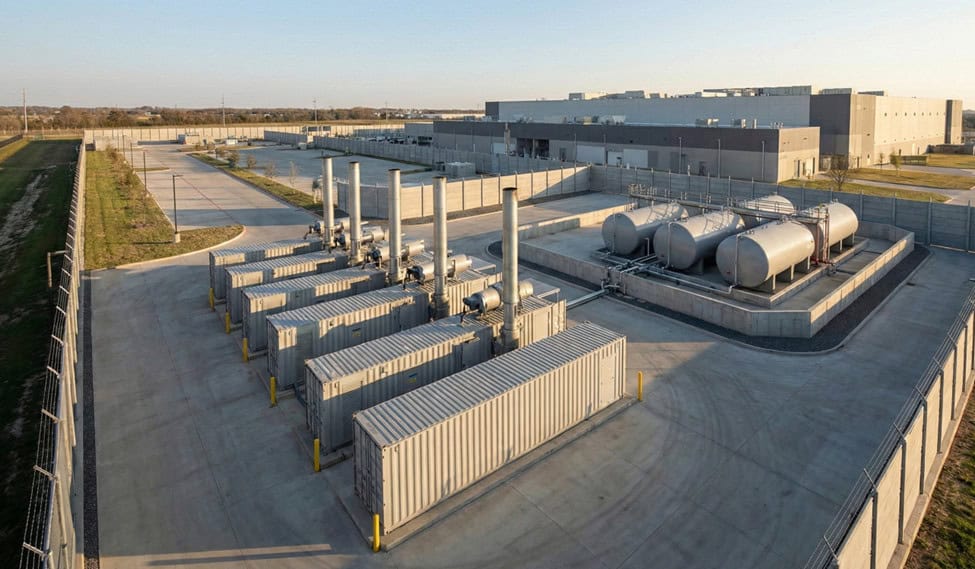
Diesel Generator Fuel Storage and Distribution
Fuel leaks can create pool or spray fires.
Controls:
- Design fuel systems per FMDS 5-23 and 7-32, and NFPA 30 and 110.
- Use leak detection and double-wall piping where appropriate.
- Separate fuel storage from critical electrical systems.
Static UPS Battery Systems
Lead-acid, VRLA, and lithium-ion battery systems introduce different risk characteristics. Lithium-ion batteries raise concerns about thermal runaway.
Controls:
- Follow FMDS 5-23 and 5-33 and NFPA 110, 111, and 855 for installation and protection.
- FMDS 5-32 (2025) more explicitly recognizes Li-Ion backup and energy systems.
- Provide ventilation and detection capable of identifying off-gas events.
- Use appropriate compartmentation and separation distances.
Rotary UPS Systems
Rotary equipment includes motors, generators, and flywheel systems that contain both electrical and mechanical hazards.
Controls:
- Apply FMDS 5-12, 5-17, 5-23, 5-33, 13-7, and 13-18.
- Maintain adequate lubrication, vibration monitoring, and enclosure protection.
- Control combustibles in proximity to rotating machinery.
Energy Storage Systems (ESS)
ESS installations for peak shaving and load support combine large quantities of lithium-ion cells. There is a high frequency of fire events in ESS applications across industries.
Controls:
- Follow FMDS 5-33 and NFPA 855.
- Use construction features that slow fire spread and allow safe venting.
- Implement thermal-runaway detection and interlocks for early intervention.
4. Liquid Release Hazards
Liquid-related losses are common and often severe. Water infiltration can damage servers, switchgear, and communication infrastructure.
Sources of Exposure:
- Roof drains
- Domestic water piping
- Chilled-water lines
- CRAC and CRAH condensate
- Steam condensate
- Coolants and hydronic systems
Controls:
- Avoid locating water piping inside or above data halls.
- Where water is unavoidable, provide leak detection consistent with FMDS 1-24 and 5-32, and with NFPA 75.
- Use secondary containment below mechanical rooms.
- Maintain drainage paths that route water away from critical equipment.
5. Emerging Considerations in AI-Driven Facilities
AI clusters impose sustained high thermal loads. GPU utilization increases cooling demand and amplifies power-system cycling. These conditions change material stress patterns and accelerate component wear.
Key emerging issues include:
- Lithium-ion UPS systems with advanced BMS requirements.
- Higher-capacity generator plants and more complex distribution schemes.
- Enhanced containment to control airflows in high-density zones.
- Grid-impact considerations due to rising electricity consumption.
- Increased reliance on ESS for peak-grid interaction.
Loss prevention planning must anticipate these factors and incorporate protective features early in design phases.
Summary
Modern data centers represent concentrated risk due to high electrical loads, combustible materials, energy-storage systems, mechanical cooling demands, and exposure to natural hazards. AI-driven growth amplifies these risks. Property loss prevention requires precise implementation of FM, NFPA, and UL standards. Fire, natural hazard, power-reliability, and liquid-damage controls must be integrated into design, construction, and ongoing operations.
Contact Risk Logic
Data centers are experiencing changes in fire load, electrical distribution, and thermal demand. These shifts require disciplined loss prevention strategies that reflect modern FM and NFPA expectations. Risk Logic provides technical evaluations, design reviews, and site-specific recommendations that help reduce exposure across fire protection, energy storage, power reliability, natural hazards, and liquid-release risk. To strengthen the resilience of existing facilities or validate new data-center projects before construction, contact Risk Logic for a comprehensive property loss prevention assessment.
FM Global Property Loss Prevention Data Sheets (FMDS)
FMDS 1-2 – Earthquakes
FMDS 1-11 – Fire Following Earthquake
FMDS 1-24 – Protection Against Liquid Damage
FMDS 1-28 – Wind Design
FMDS 1-40 – Flood
FMDS 2-0 – Installation Guidelines for Automatic Sprinklers
FMDS 2-8 – Earthquake Protection for Water-Based Fire Protection Systems
FMDS 4-2 – Water Mist Systems
FMDS 4-9 – Halocarbon and Inert Gas (Clean Agent) Fire Extinguishing Systems
FMDS 5-12 – Electric AC Generators
FMDS 5-14 – Telecommunications Systems
FMDS 5-17 – Motors & Drives
FMDS 5-31 – Cables and Bus Bars
FMDS 5-32 – Data Centers and Related Facilities
FMDS 5-23 – Emergency and Standby Power Systems
FMDS 5-33 – Electrical Energy Storage Systems
FMDS 5-48 – Automatic Fire Detection
FMDS 7-32 – Ignitable Liquid Operations
FMDS 9-13 – Evaluation of Flood Exposure
FMDS 9-19 – Wildland Fire
FMDS 13-7 – Gears
FMDS 13-18 – Industrial Clutches & Clutch Couplings
FM Approvals Standards
Class Number 3972 – Test Standard for Cable Fire Propagation
Class Number 4882 – Approval Standard for Class 1 Interior Wall & Ceiling Materials or Systems for Smoke Sensitive Occupancies
Class Number 4910 – Examination Standard for Cleanroom Materials
Class Number 4924 – Approval Standard for Pipe and Duct Insulation
National Fire Protection Association (NFPA) Codes/Standards
NFPA 13 – Standard for the Installation of Sprinkler Systems
NFPA 30 – Flammable & Combustible Liquids Code
NFPA 37 – Standard for the Installation and Use of Stationary Combustion Engines and Gas Turbines
NFPA 70 – National Electrical Code, Article 645
NFPA 72 – National Fire Alarm & Signaling Code
NFPA 75 – Standard for the Fire Protection of Information Technology Equipment
NFPA 76 – Standard for the Fire Protection of Telecommunications Facilities
NFPA 110 – Standard for Emergency and Standby Power Systems
NFPA 111 – Standard on Stored Electrical Energy Emergency and Standby Power Systems
NFPA 262 – Standard Method of Test for Flame Travel and Smoke of Wires and Cables for Use in Air-Handling Spaces
NFPA 274 – Standard Test Method to Evaluate Fire Performance Characteristics of Pipe Insulation
NFPA 287 – Standard Test Methods for Measurement of Flammability of Materials in Cleanrooms Using a Fire Propagation Apparatus (FPA)
NFPA 855 – Standard for the Installation of Stationary Energy Storage Systems
NFPA 1143 – Standard for Wildland Fire Management
NFPA 2001 – Standard on Clean Agent Fire Extinguishing Systems
References
References include but are not limited to:
International Energy Agency (2023–2024). Data Centers and Data Transmission Networks.
McKinsey & Company (2023). Data Center Economics and AI Impact.
Uptime Institute (2023–2024). Global Data Center Survey.
Synergy Research Group (2024). Hyperscale Growth Reports.
Gartner & IDC (2024). Cloud Infrastructure and AI Market Analyses.
Eaton, Schneider Electric, Vertiv (2024). Lithium-ion UPS Migration Data.