Technical Article: Power, Preparedness, and Prevention – Lessons from the North Hayes Substation Fire
1. Introduction - Lessons from the North Hayes Substation Fire Late on the evening of March 20, 2025, engineers worldwide were reminded just how vulnerable our most critical infrastructure can be....
1. Introduction - Lessons from the North Hayes Substation Fire
Late on the evening of March 20, 2025, engineers worldwide were reminded just how vulnerable our most critical infrastructure can be. A fire at the North Hayes electrical substation in West London resulted in a massive power outage that affected 4,900 homes and brought Heathrow Airport, the world's busiest single-runway airport, to a standstill. While government officials declared the event “unprecedented,” for those in the field of electrical infrastructure and loss prevention, it was also a stark warning: our systems are only as strong as their weakest link. From this, we can come up with lessons from the North Hayes substation fire.
In this article, we examine the incident and discuss how NFPA and FM standards can inform on better protection, smarter design, and enhanced resilience in substations and the critical infrastructure they support.
2. A Fire That Sparked Questions
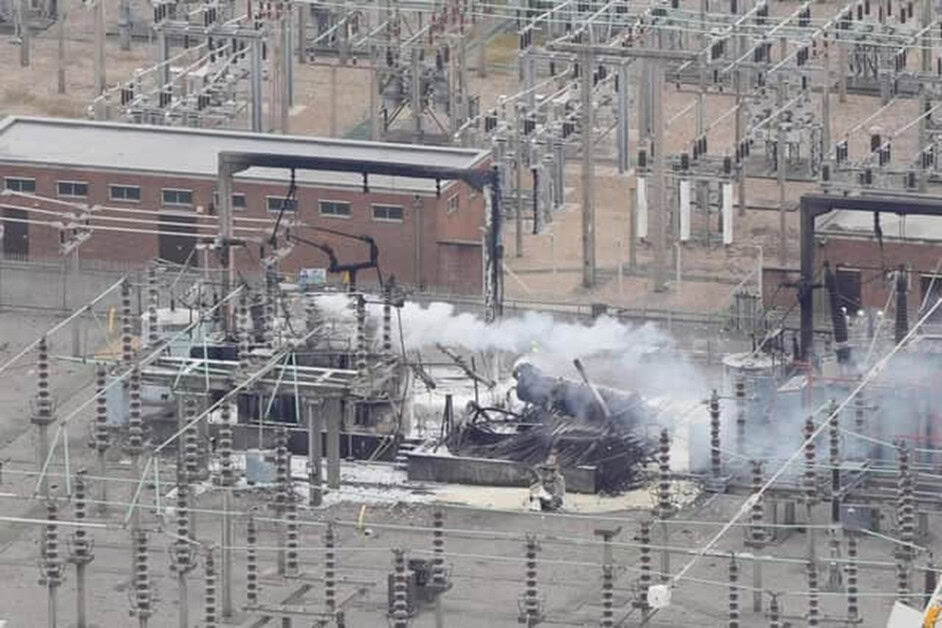
The London Fire Brigade received the first emergency call at 23:23 GMT. Within minutes, 10 fire engines and 70 firefighters were on the scene, battling flames and smoke pouring from one of the site's large transformers. The culprit? An uncontrolled release and subsequent ignition of approximately 25,000 liters of cooling oil. Thankfully, the concrete bunds did their job in containing the oil—but not the damage.
Although the transformers were equipped with water deluge systems, they appeared to have been rendered ineffective, possibly due to an initial explosion reported by nearby residents. The result was a prolonged burn that impacted residential power supplies and shuttered operations at Heathrow.
One hundred eighty people were evacuated from their homes, and 4,900 customers were left without power. Remarkably, Heathrow Airport, which appeared to lack an independent backup supply of sufficient capacity, was forced into emergency mode. Flights were delayed and/or cancelled, passengers stranded, and reputations bruised. As a privately operated entity, Heathrow’s inability to source alternative power or ensure operational diversity is a troubling oversight—one that demands scrutiny.
3. Understanding the Infrastructure
The North Hayes facility is a distribution substation tasked with stepping down voltage for local use. While transmission substations deal with the high-voltage backbone of the grid, distribution substations are the last significant link in the chain before electricity reaches consumers. And when one of them fails, especially in a location serving a major transport hub, the consequences are felt instantly.
The government has launched a six-week investigation involving counter-terrorism officials, a standard protocol for an incident of this magnitude. But as engineers, we don’t need to wait for official findings to begin reflecting and responding.
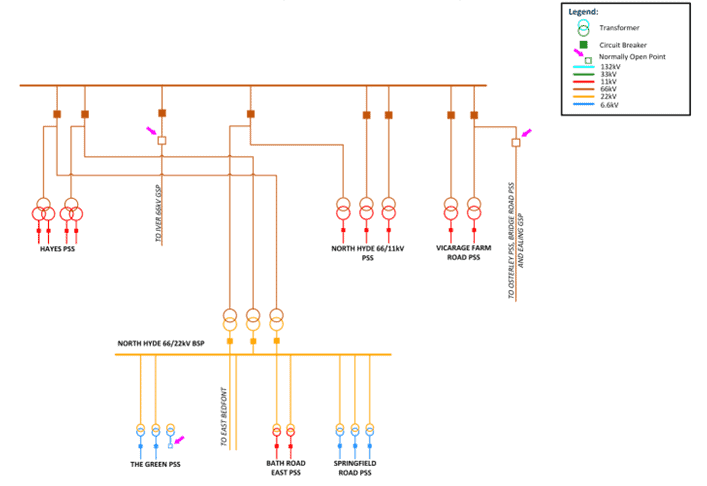
It appears that the middle transformer in the schematic, the ‘North Hyde 66/11kv PS5’, was the transformer that failed. The current topology of the network supplied by North Hyde GSP is shown in Figure 2 below.
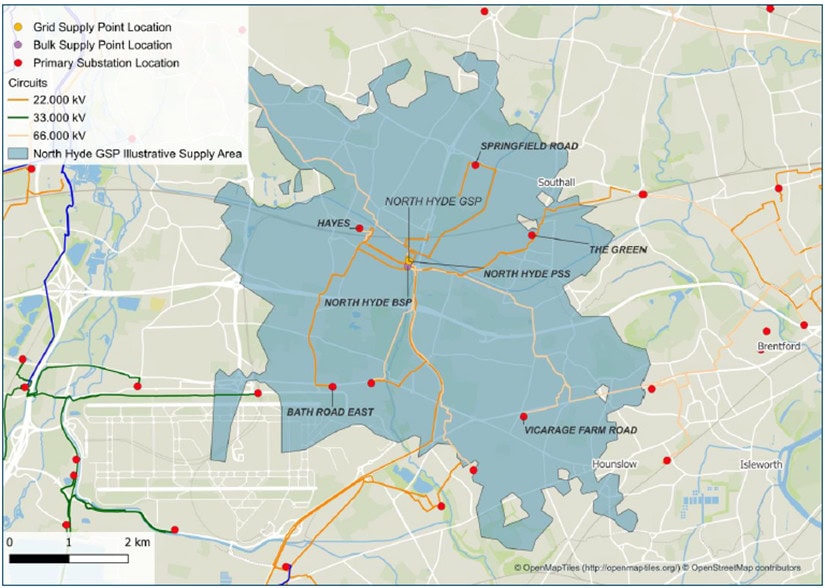
Heathrow Airport is visible in the bottom left corner of Figure 2, and multiple grid connection points appear to supply the airport. The complexity and interconnectedness of airport systems, including safety systems, will make identifying the weak points within the airport infrastructure and their solutions very challenging. A thorough investigation will be required to identify the weaknesses and mitigate them promptly.
4. Engineering Resilience: Best Practices from NFPA and FM
With the full investigation set to last six weeks, it is not yet known what caused the fire. What mitigating factors should have been in place? More importantly, what should we all be looking to implement now?
4.1 Assessing and Reducing Fire Risk
- Conduct detailed fire risk assessments in accordance with NFPA 850 (2020 Edition), Recommended Practice for Fire Protection for Electric Generating Plants and High Voltage Direct Current Converter Stations, particularly at sites that handle flammable dielectric fluids.
- Incorporate predictive maintenance strategies outlined in NFPA 70B, Standard for Electrical Equipment Maintenance, including thermal imaging, infrared scanning, visual inspections, and electrical testing to identify deficiencies before they escalate into a fire or explosion.
- Follow FM Property Loss Prevention Data Sheet (FMDS) 5-4, Transformers, to reduce fire risk from transformer units, including regular testing and maintenance of pressure relief devices.
4.2 Designing for Redundancy
- Dual feeds from separate substations are not a luxury—they’re essential. FMDS 5-4 makes this clear for critical sites.
- Emergency generators and UPS systems, maintained per NFPA 110, Standard for Emergency and Standby Power Systems, should be capable of supporting essential operations.
- Automation and transfer schemes should allow a near-seamless transition in the event of failure.
4.3 Detection and Suppression That Work When Needed
- Substations require robust, early-warning systems, such as aspirating smoke detectors and infrared flame detection; NFPA 72, National Fire Alarm and Signaling Code®, provides the framework.
- Physical barriers and adequate spacing between transformers (NFPA 850 and FMDS 5-4) can help contain a fire and prevent escalation.
4.4 Hardening the Asset, Physically and Digitally
- NFPA 855, Standard for the Installation of Stationary Energy Storage Systems, and IEC 62443 standards provide best practices for protecting against physical attacks and cyber threats.
- Enclosures should be designed to withstand external hazards—whether environmental or intentional.
- Conduct resilience audits and live drills. Test your system under pressure before it fails under pressure.
4.5 Train for the Worst
- Condition-based maintenance, partial discharge monitoring, and Dissolved Gas Analysis (DGA) are essential.
- Train site staff and first responders using NFPA 600, Standard on Facility Fire Brigades protocols.
- Simulate failure scenarios and refine response plans accordingly.
5. The Takeaway
From missed signals to missed opportunities, the North Hayes incident is likely to leave us with lessons we cannot afford to ignore:
- Redundant power sources must be independent and immediate.
- Backup systems for critical infrastructure must be scaled to handle the full operational load—not just lighting and IT.
- Critical facilities must treat power diversity as a boardroom priority, not just an engineering checkbox.
- Ongoing testing and maintenance of critical infrastructure is essential.
- As a private entity, Heathrow Airport will now have questions to answer. An event such as this can destroy a reputation that has taken a lifetime of hard work to build.
6. Closing Thoughts
As loss prevention engineers, we understand that fires can occur. Failures happen. What we cannot allow is for them to take down the very systems that society relies on to function. This fire was a wake-up call. Let’s not hit the snooze button again.
Is your facility at risk of electrical outages? Contact Risk Logic today to have a thorough analysis of the electrical power distribution system resiliency, and the inspection, testing and maintenance to ensure that all reasonable mitigating measures are in place.
7. Further Reading and References
- NFPA 70B: Recommended Practice for Electrical Equipment Maintenance
- NFPA 72: National Fire Alarm and Signaling Code
- NFPA 110: Standard for Emergency and Standby Power Systems
- NFPA 2001: Standard on Clean Agent Fire Extinguishing Systems
- NFPA 850: Recommended Practice for Fire Protection for Electric Generating Plants
- FM Data Sheets 5-4, 5-9
- IEC 62443: Industrial Cybersecurity
- https://www.nationalgrideso.com
Read more in: