How to Protect Your Facility from Hailstorm Damage
When the sky darkens and the rumble of thunder rolls in, your facility could be just minutes away from a costly hailstorm disaster. Imagine baseball-sized hailstones crashing down—shattering...
When the sky darkens and the rumble of thunder rolls in, your facility could be just minutes away from a costly hailstorm disaster. Imagine baseball-sized hailstones crashing down—shattering skylights, denting HVAC units, and turning your roof into a leaky mess. But here's the good news: With the right strategies, you can protect your facility from hailstorm damage and save yourself from the headache (and expense) of unexpected repairs. Read on to discover how to protect your facility from hailstorm damage with smart moves to keep your business safe when Mother Nature throws her worst your way!
Is my facility exposed to hailstorms?
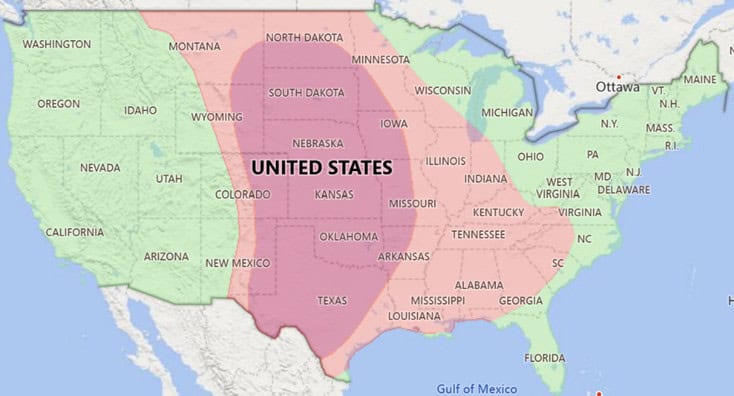
If your facility is outside of the Great Plains region of the United States (think the central part of the country spanning from Texas to the southern half of North Dakota and from Denver, CO to Des Moines, IA), you probably don’t consider hail to be much of a concern. However, severe hailstorms can impact facilities anywhere east of the Rocky Mountains to Chicago, IL, Charlotte, NC, and as far as southern Georgia. FM classifies hail exposure in the United States into three categories as shown in the map below: Moderate (MH) in green, Severe (SH) in light red, and Very Severe (VSH) in dark red. You can use these regional classifications as a general guide to gauge your facility’s exposure to damaging hailstorms. VSH areas are those with the most prevalent reports of hail ΓëÑ 4 in. diameter from 2009-2021. Damaging hailstorms can also occur in MH areas but are not as common.
How does a storm become a hailstorm?
Hailstorms are a type of convective storm characterized by intense upward atmospheric motion within convective cloud systems. Thunderstorm updrafts carry raindrops upward into extremely cold areas of the atmosphere, where they freeze and form hailstones. Hailstones then grow by colliding with liquid water drops that freeze onto the hailstone’s surface. Hail falls when it becomes heavy enough to overcome the thunderstorm updraft's strength, and gravity pulls it toward the earth. Hailstones can vary in size from smaller than pea-sized to larger than baseball-sized.
Can hailstorms really be that damaging?
Hailstorm damage is usually greatest to building roofs, rooftop HVAC units, and skylights. Cooling towers and other outdoor equipment can suffer damage as well. While some of the largest hail losses have been to outdoor storage of vehicles.
The severity of hailstorm damage is largely determined by the size of the hail produced. Hailstones can cause substantial property damage through impact, and this damage often worsens as water infiltrates the openings created by the hail.
In a 2021 comparison of severe weather impacts, the National Weather Service (NWS) reported that property damages from hailstorms exceeded $1.25 billion. This is only exceeded by damages from tropical storms/hurricanes ($8.60 billion), coastal storms ($3.58 billion), flash floods ($2.43 billion), and fire weather/wildfires ($2.09 billion).
The second costliest hailstorm in US history occurred on May 8, 2017. The storm produced baseball-sized hailstones, which battered the west metro area of Denver, Colorado, resulting in property damages of over $2.3 billion. The Colorado Mills Mall in Lakewood experienced significant roof damage and subsequent water intrusion from this event, which forced the mall to be closed for over six months while repairs were completed. The water damage destroyed store interiors and ruined millions of dollars of inventory. Further, the city of Lakewood indicated they could experience an estimated loss of $350,000 in sales tax revenue for each month the mall was closed.
According to reporting by Denverite, the roof of the mall had not undergone any major repairs, according to city records, since its opening in fall 2002. This implies the roof system was around 15 years old, which is not uncommonly old for a typical commercial roof and is within the typical commercial roof warranty period. However, the originally installed roof may not have been properly designed for the current hail exposure. Further, the mall had numerous skylights, which, if not properly designed, are highly susceptible to damage from hail.
How can I protect my facility from hailstorm damage?
FM Property Loss Prevention Data Sheet 1-34, Hail Damage, provides industry-leading guidance on how to best prevent your facility from experiencing significant hailstorm damage. Most recommendations are targeted at those facilities in the SH and VSH regions, but facilities in the MH region can always benefit from enhanced protection features. Note: The following guidance is specific to addressing the hail exposure of a facility. Additional considerations are needed for other natural hazard exposures as well as the potential impacts to sprinkler protection.
Construction
The following are recommended for facilities in all hail-exposure regions:
- When constructing a new building or re-roofing your existing facility, install roof assemblies recommended for use in the facility’s hail exposure zone as specified in Table 2.3-1 below. FM’s┬áRoofNav┬ásystem can be used to find properly rated roof assemblies.
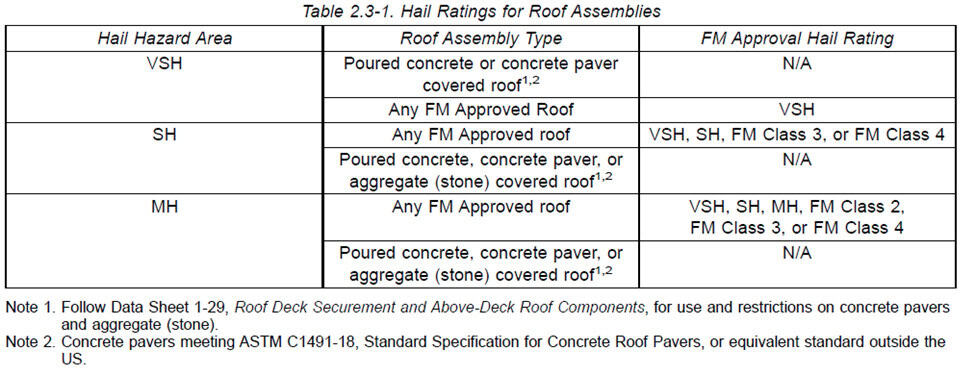
- Similarly, select exterior wall panels and skylights that have the proper FM hail rating. The FM Approval Guide can be used to find these products.
- Where the local authority having jurisdiction (AHJ, also referred to as the “code official”) requires smoke and heat vents, select vents with the proper FM hail rating.
Equipment
The following are recommended for facilities in the SH and VSH regions
- Provide hail guards over the condenser cooling fins on heating, ventilating, and air conditioning (HVAC) equipment.
- Ensure critical outdoor equipment that is resistant to hail with an impact energy of 53 ft-lb (VSH) or 14 ft-lb (SH) or provide hail guards.
When hail guards are recommended, contact the equipment manufacturer for compatible hail guards. Ensure they do not interfere with the equipment’s operation. Hail guards are available in several different materials, but maximum openings should be 0.5 by 1.0 in. They can also be constructed from a minimum No. 11 gauge (0.1205 in.) diameter steel wire mesh with a maximum mesh opening size of 0.5 by 1.0 in. supported by a steel framework. Increase the wire size by one gauge if the shortest span (distance between supporting frame members) exceeds 6 ft.
Human Factor
We recommend the following programs to ensure exterior building components and equipment remain in adequate condition to withstand hailstorms:
- Inspect and maintain roofs in accordance with FM Property Loss Prevention Data Sheet 1-32, Inspection and Maintenance of Roof Systems. Repair deficiencies or replace roofs with deficiencies over large areas or nearing the end of their useful life. The average life expectancy of most single-ply and multi-ply roof covers is between 14 and 18 years.
- Inspect nonmetallic heat and smoke vents and skylights for cracks, crazing, yellowing or discoloration, increased cloudiness, or other damage or indications of embrittlement due to weathering and aging. Replace as needed.
- Inspect hail guards on HVAC equipment for proper condition and securement.
Learn how to prepare for extreme weather in our January 2022 article.
What about my solar photovoltaic panel systems?
Due to their make-up, solar photovoltaic (PV) systems are uniquely susceptible to hailstorm damage. Exposure to hail beyond the panels' tested limits will likely damage all modules in the array(s).
Roof-mounted systems
To best protect your facility’s roof-mounted solar PV systems, use PV modules that have hail ratings (established in accordance with FM Approval Standard 4478 or 4476) as recommended for the facility’s hail exposure zone as listed in FM Property Loss Prevention Data Sheet 1-15, Roof-Mounted Solar Photovoltaic Panels, Table 2.1.4.1.

Ground-mounted systems
For ground-mounted solar PV systems, apply the following guidance:
- Use PV modules that have hail resistance ratings recommended for the facility’s hail exposure zone. The current test methods for solar panels used in ground-mounted applications are ANSI/FM 4473 and UL 61730/IEC 61215. When using these test methods, ensure test conditions reflect hail size and minimum impact energy according to FM Property Loss Prevention Data Sheet 7-106, Ground-Mounted Solar Photovoltaic Panels, Table 2.1.3.1.

- Design and construct variable tilt solar arrays to allow for defensive hail stow strategy in damaging hail prone zones. Automate defensive hail stow based on alerts from a reputable weather service provider on a 24/7 basis.
Develop defensive hail stow protocols for variable title solar arrays with the following in mind:
- Contract with a reputable weather service provider. Arrange for the weather service provider to advise the operators in advance of any potential hail events on a 72-, 48-, and 24-hour basis.
- Develop procedures and train operators and on-site personnel to initiate defensive hail stow positions 24/7 based on weather service alerts. Defensive hail stow positions should be initiated at least 30 minutes before the hailstorm arrives at the perimeter of the solar farm, plus the time needed for the tracker systems to reach the maximum defensive stow position and verify stow has been achieved.
- Periodically, and at least quarterly, test and validate hail stow protocols to ensure adequate response and functional operation of the tracker systems. Document test results for trend analysis.
- Stow PV modules at the maximum allowable wind design speed angle away from the prevailing hailstorm approach direction for:
- Solar farms under construction (before energization and commissioning)
- Operational farms between sundown and sunrise
- For locations under construction, implement stow protocols for the power blocks that have been commissioned and generate power.
Human Factor
Check all solar photovoltaic panel system equipment for damage or required maintenance after severe weather events or at intervals not exceeding six months.
Act Now
Don't wait until the next hailstorm puts your facility at risk! At Risk Logic, Inc., we specialize in comprehensive property loss prevention strategies that safeguard your business from costly hailstorm damage. Our expert team can assess your facility's exposure and recommend tailored solutions. We can help you implement proven best practices to keep your operations running smoothly—no matter the weather.
Ready to protect your facility and your bottom line? Contact us today to schedule a consultation and prepare your business for whatever Mother Nature throws your way!
Sources
FM Property Loss Prevention Data Sheet 1-34, Hail Damage
FM Property Loss Prevention Data Sheet 1-15, Roof-Mounted Solar Photovoltaic Panels
FM Property Loss Prevention Data Sheet 7-106, Ground-Mounted Solar Photovoltaic Panels
FM Nathaz toolkit and maps: www.fm.com/resources/nathaz-toolkit
NOAA Severe Weather 101, Hail Basics: www.nssl.noaa.gov/education/svrwx101/hail/
NOAA Summary of Natural Hazard Statistics for 2021 in the United States: https://www.weather.gov/media/hazstat/sum21.pdf
NOAA Top 12 Events of the 2010s in Colorado, #4 The Second Costliest Hailstorm in U.S. History: https://www.weather.gov/bou/May8_2017_Hailstorm
Read more in: